
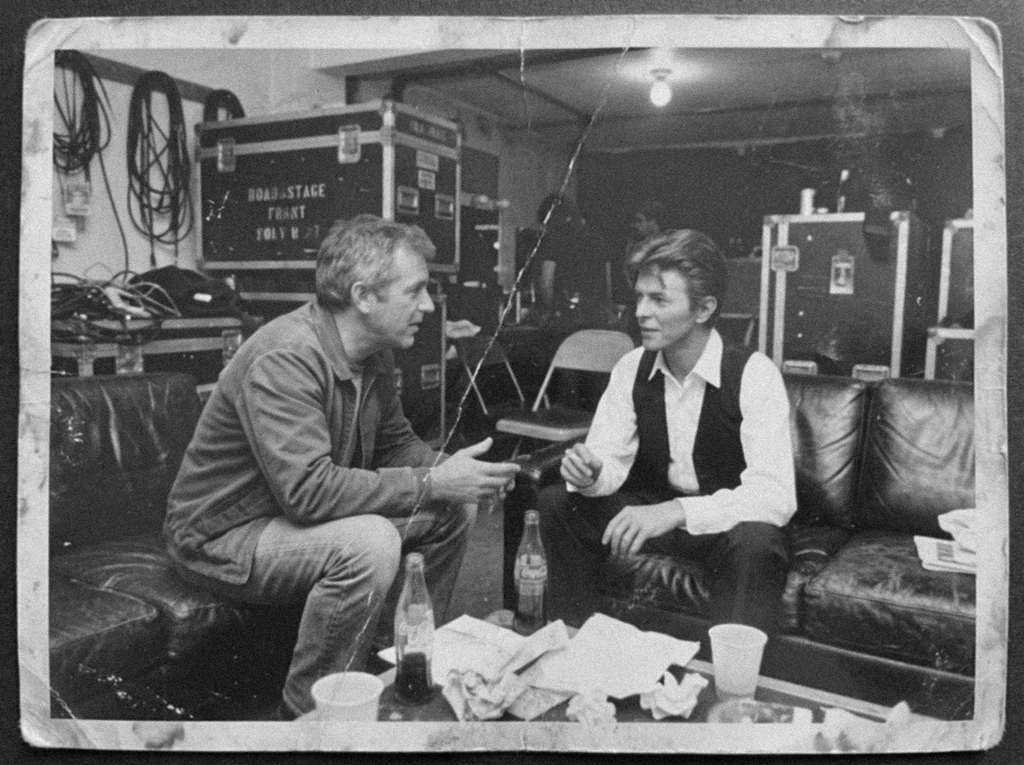
I treasure this photo of my backstage meeting with David Bowie at the Forum in Los Angeles before the Station to Station show in 1976. What a memory!
We’ve crossed a threshold and it’s because of AI.
Of course it is. The phrase “because of AI” can be added to everything that happens now. The planes can’t fly . . . because of AI. (Maybe.) We found more elephants . . . because of AI. Anthropic’s prediction that it might destroy humanity makes it one of the most valuable companies on earth . . . because of AI.
Today’s sermon is about trust and how AI is taking away your ability to believe your eyes and ears and what you have to do to be safe.
Effective now, today, it is no longer possible to know whether any photo, video, email, text, voice on the phone, or person in a video chat is real.
Don’t trust anything. Don’t trust anyone. Don’t trust any photo or video that you see online. Don’t trust your boss when he Zooms unexpectedly to set up a wire transfer. Don’t trust your beloved grandson when he Facetimes from a Turkish prison. Don’t trust the nice lady who calls from your bank’s fraud prevention department. Don’t trust Tom Hanks when he sends you an email about an exciting investment opportunity. Don’t trust the Pope if he sends you a text message asking for an Apple gift card. Don’t trust me – I saw the Bowie show but the photo is just a fantasy, the product of fifteen minutes with Gemini.
This sounds familiar, doesn’t it? Being careful about scams is nothing new. I started writing annual safety guides more than twenty years ago and kept it up until recently. You’ve heard the warnings – don’t open email attachments, don’t click on links or call the “support” numbers in email messages, don’t answer calls or respond to texts from unknown numbers, there’s nothing new there, that’s been our world for a long time.
But there were always giveaways: the email message had typos; the sender’s email address didn’t match the company; the link to click on didn’t lead to a trustworthy URL; something didn’t smell right. You were smart and careful and you’re not like the unsophisticated folks, you weren’t going to be fooled.
Those days are over. Your defenses have to be strengthened tenfold.
Don’t Trust Your Eyes

Jensen Huang was not caught on the Jumbotron with Alice Huang at a Coldplay concert. Alice Huang was not filmed staring at Jensen Huang with eyes wide open, saying “Why would I deceive you?” Jensen Huang was not photographed wearing a studded biker jacket. Jensen Huang did not run into the Nvidia offices and jump into a wrestling ring after getting the CEO job back yesterday.
Yet you might have seen any of those scenes in completely realistic photos or videos, or hundreds of others that flooded out in the days after his resignation and return. Calling them “deepfakes” makes them sound too sinister, so “memes” seems to be the chosen term.
Nothing gives them away as AI generated. We are far past the hands with six fingers and garbled words that were giveaways of AI content in the dark ages six months ago. Today anyone can use ChatGPT or other consumer AI tools to create media that is indistinguishable from authentic photos or videos.
This is a generational change that has happened in an eyeblink. For our entire lives we have believed that photos and videos are evidence that something really happened. They could be manipulated but it required specialized skills, expensive equipment, and considerable effort. Those days are gone forever.
There are no visual clues in today’s AI-generated pictures. It takes seconds to generate a photo of a real person doing something they never did or picturing a scene that doesn’t exist. For scammers, this means fake product listings, counterfeit identity documents, imaginary vacation properties, fabricated evidence of accidents, and pictures that appear to confirm an invented emergency. Do you understand the point? You can’t tell by looking at them whether they’re real or fake.
AI can also now create videos with no giveaways. A SUNY professor describes AI video deepfakes this way: “Video realism made a significant leap thanks to video-generation models designed specifically to maintain temporal consistency. These models produce videos that have coherent motion, consistent identities of the people portrayed and content that makes sense from one frame to the next. . . . These models produce stable, coherent faces without the flicker, warping or structural distortions around the eyes and jawline that once served as reliable forensic evidence of deepfakes.”
Don’t trust your ears
Fish Audio needs as little as ten seconds of a recording of someone’s voice to build a surprisingly accurate clone. But if you want a completely convincing replica of a voice, get a minute or so of a recording of someone talking and go to ElevenLabs. It’s the gold standard for realism and emotional nuance, capturing subtle breathing patterns, pacing, and natural inflection from clips as short as sixty seconds. The entry-level plan is around $5/month.
Does your partner or child or boss have anything on YouTube – a presentation or speech, perhaps? That’s more than enough raw material to clone their voice. Then a scammer types a message, the cloned voice reads it, and voila, your boss leaves a message in her distinctive voice asking for a wire transfer.
But that’s not all. The AI advances in 2026 can transform speech in real time. A criminal calls you. His speech is transformed into your boss’s voice as you talk, answering questions about the offshore payment she’s requesting – pitch, accent, rhythm, pronunciation, just like your boss. Or you get a frantic call from your daughter, sobbing that she’s been arrested and needs bail money, and obviously it’s her, it sounds just like her. Except it’s not.
As I write this in November 2026, AI-deepfake calls with cloned voices are not widespread. So far the scammers have mostly focused on wealthy victims. But the technology is basically already good enough, and the AI tools are getting cheaper and easier to use every day. Starting today, you have to assume that recognizing someone’s voice is no longer reliable evidence that you’re talking to that person.
The final frontier: real-time fake video
UC Berkley professor Hany Farid is one of the world’s leading deepfake experts. For decades he has made a career of sorting out real videos from fake clips for governments, human rights organizations, journalists, law enforcement, and others. In the last six months, he has stopped trusting his own eyes. There are no longer any clues in videos of a missile streaking toward an Iranian school, or a video of an explosion at the Pentagon that briefly rattled the stock market and erased $500 billion in a few minutes in 2023. “Within a year or two, our whole visual system will be utterly useless,” he says in a New York Times profile this summer. He and his wife are moving to Vermont. “I can’t stand this place anymore. These major tech giants will burn everything to the ground as long as they’re making a profit. They’re not interested in anything that’s going to slow them down.”
The next step is real-time video impersonations that reproduce the appearance and voices of real people in live conversations – and that’s already technically possible and being used by bad guys.
In 2025 the CFO of a company in Singapore transferred $500,000 after a Zoom call in which all participants were AI-generated, including his boss. Fraunhofer Institute for Secure Information Technology in Germany reported in August that there has been a massive increase in video fraud cases like that in 2026.
Two weeks ago the New York Times reported that $129 million had been stolen from US companies in 18 months using AI-generated video and phone calls to impersonate CEOs or other executives. The F.B.I. Internet Crime Complaint Center’s 2025 report describes more than 22,000 complaints where AI was used to create realistic phishing emails, clone voices for family emergency/distress scams and enhance romance fraud scripts.
The death of trust
Wow, this is dark, isn’t it? Imagine my surprise that writing about AI’s effect on society goes to a dark place. Gosh.
It’s not good for us as human beings to feel we can’t trust our own senses. There’s a psychological toll if we routinely question whether people we see and hear are who they appear to be. People will believe things that never happened, and people will refuse to believe things that actually happened. Researchers call it the liar’s dividend: anyone caught on camera doing something reprehensible has a plausible excuse that didn’t exist before – just claim it was AI.
There are precautions you can take. The big one: Slow down when someone creates urgency. Emergencies, secrecy, and demands for immediate payments are classic fraud tactics, whether AI is involved or not.
The second one is also longstanding: Verify through a separate channel. Call your child or your boss through a different method that you know is legitimate.
The third turned up as advice from many professionals, and it’s such a horrible reflection of our world: Establish a family verification phrase, a private phrase for unexpected emergencies. How sad is it that we have to even think about that?
And finally, the advice that you have to take to heart: Don’t trust yourself to spot fakes. Those days have passed. “In a test, only 8% of people realized an AI agent was calling them, whereas 92% of people thought they were speaking to a human,” said Kevin Tian, founder of Doppel, a social engineering defense platform for AI-enabled threats. Less than 10% of people guess that an AI is on the line? That’s pretty harsh. Here’s a much more generous take which gets us up to fifty/fifty. Security and identify verification company Veriff released a research report earlier this year with this conclusion: “Can people actually tell real from fake? The overall findings suggest most people are aware of deepfakes, yet their ability to distinguish them from reality is barely better than a coin flip.”
Trust your fellow humans! Just make sure there’s a fellow human involved.