
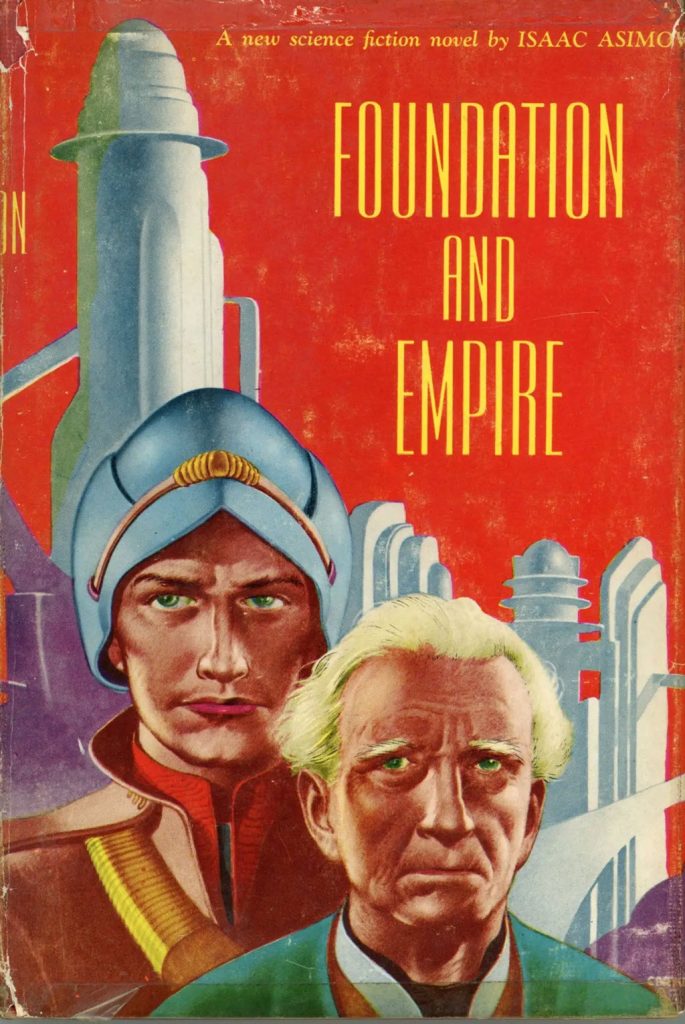
Isaac Asimov published the novella “The Mule” in Astounding Science Fiction magazine in 1945. A few years later it became the second half of Foundation and Empire, the second book of the Foundation trilogy.
Asimov’s Foundation books are among the most celebrated works in science fiction, crowned with a special Hugo Award for Best All-Time Series.
There’s a lesson we should have learned from Foundation. Maybe we would have been better prepared for our current crisis.
Foundation is a grand epic set 50,000 years in the future, studying the decline and fall of the Galactic Empire. When the story opens, the rational, enlightened, science-friendly Foundation has triumphed and seems secure.
Everything changes when the Mule, a terrifying warlord, conquers the Foundation in the space of a year. The Mule emerges from obscurity, cloaked in misdirection, even ridicule. Early on, he is underestimated or misidentified, dismissed as a minor player or curiosity, but his disruption causes everything to fall apart.
All of civilization suffers because of a single outlier who ignores the traditional rules.
Isn’t it obvious?
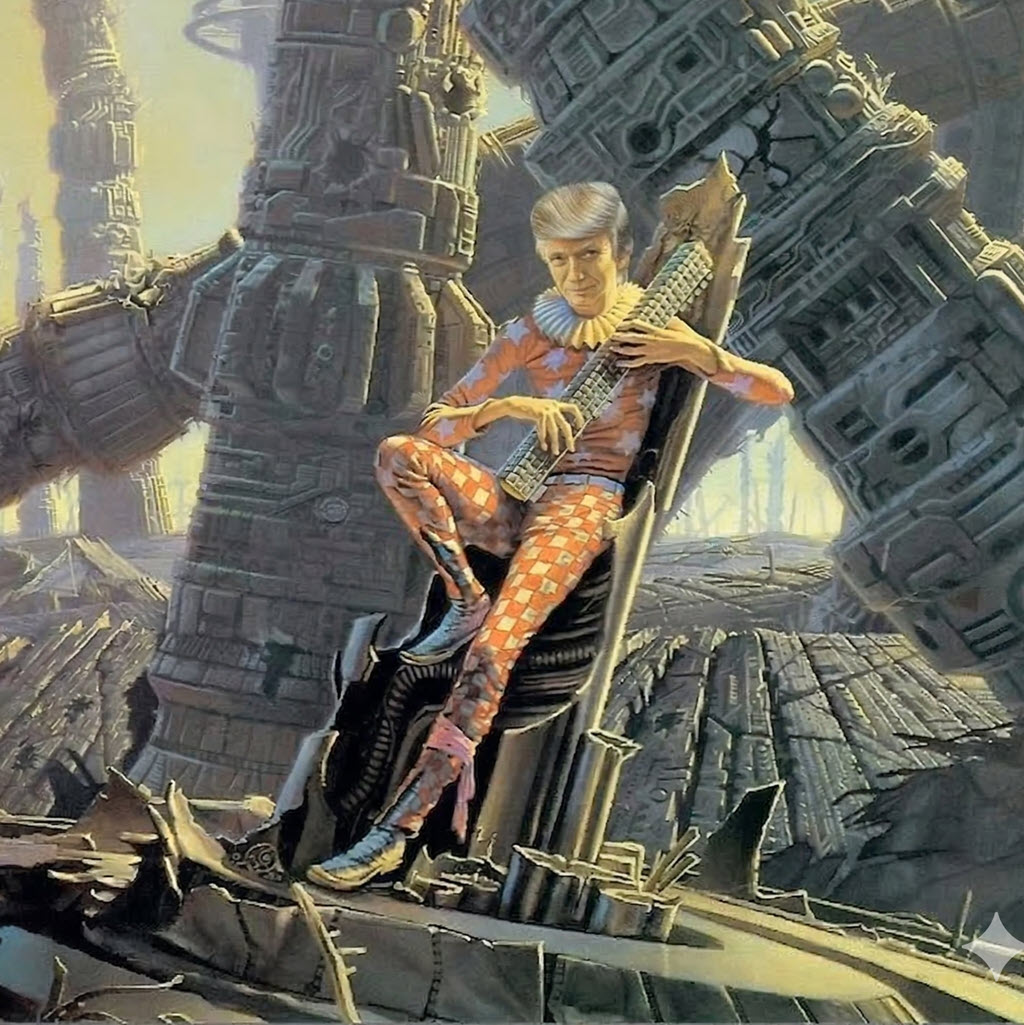
Donald Trump is the Mule. If you’ve read the books, you’re already nodding your head, ah, yes, of course he is. (The picture above is Michael Whelan’s iconic painting of the Mule with altered hair.)
I wish I could tell you that the series has a happy ending but sorry, everything falls apart. The Mule demoralizes the scientists and leaders, sets up an autocracy that he uses for his personal obsessions, and changes the course of history for hundreds of years.
The Mule is a mutant with telepathic powers. Trump does not use telepathy to bend people to his will. As far as we can prove.
But look at the similarities.
The Mule arrives in the Foundation series like a statistical error that refuses to be rounded away. The Foundation is built on the fictional science of “psychohistory,” which predicts the future of galactic civilization on the assumption that human behavior, in aggregate, behaves like weather: turbulent but predictable. Then the Mule shows up and turns the forecast into confetti.
Today’s pollsters and data modelers are the real world equivalent of the Foundation’s “psychohistorians.” Our modern data scientists were caught flat-footed in 2016 by an outlier they weren’t programmed to see.
The Mule flips the most loyal Foundation politicians into his most devoted servants by inducing a state of intense, unshakable loyalty. Opponents feel despair and “a miserable sense of defeat.” Sound familiar? You can’t outmaneuver an opponent who makes politicians want to lose.
The Mule first appears in the guise of Magnifico, a pathetic, spindly court jester. His clown persona makes his enemies underestimate him until it’s too late. Trump used the persona of a bombastic reality-TV act, a difference of detail, not of kind.
In the stories, people who previously held contradictory views are suddenly converted into total alignment with the Mule’s agenda, discarding their long-held principles. Armies and institutions crumble not because they are defeated in the field, but because the people inside them are quietly, irresistibly rewritten. Resistance becomes devotion; skepticism becomes faith. It is conquest by editing the emotional script of entire populations.
Trump might not be telepathic but that’s almost a better explanation for the cowardice and caving of American institutions and its leaders.
The books describe a centralized autocracy replacing the democratic government and stalling further advancement. The focus shifts from science and innovation to maintaining the Mule’s personal grip on power.
The Mule’s reign creates a more paranoid and less stable geopolitical environment. Today we’d call it a “Black Swan” event – a rare, unpredictable shock with enormous consequences.
Political writer John Judis argued last week that Trump is a Hegelian world-historical figure – “a figure of enormous historical significance who is reshaping America and the globe in ways that will not easily be undone by Democratic wins in future elections.”
“The idea here is not that the figures in question — an Alexander or Caesar or Bonaparte, the figures Hegel thought of — are good people. It’s not even that they necessarily have any articulate awareness of their role in history. It’s that there are some individuals who have an intuitive sense of the opportunities of the historical moment. They then acquire power and force huge changes that drive the course of history in dramatically new directions, directions that are essentially impossible to undo. The key is there’s really no going back from the changes these people make.”
It’s a convincing argument, well worth a look.
But to me, Donald Trump is the Mule. We didn’t see him coming. We didn’t recognize his significance.
Late in the books, the leader of the Second Foundation tells the Mule why society was not ready to resist him: “We thought we were prepared. We allowed only for megalomania—not for an intensely psychopathic paranoia as well.”
We thought we were prepared. We weren’t. And unlike Asimov’s universe, there may be no hidden Second Foundation waiting to set things right.