
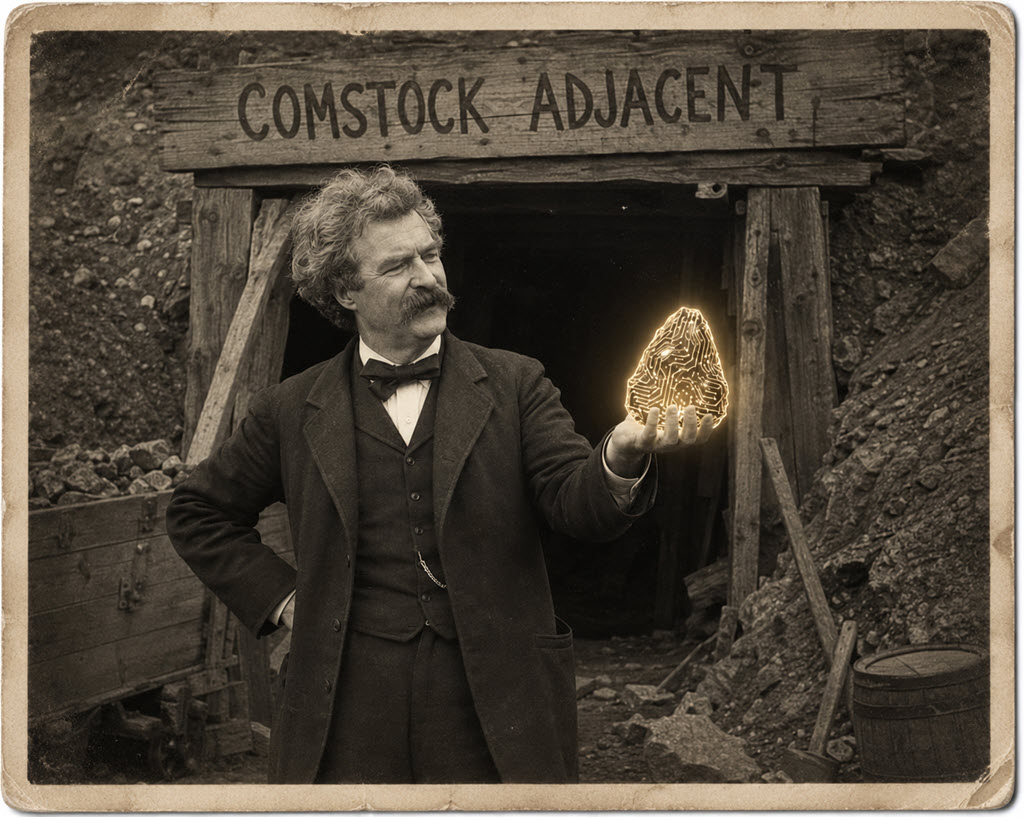
As of mid-2026, there are roughly 70,000 AI companies. About half of all global venture capital funding is pouring into pure-play AI startups.
The indications are good.
Remember that phrase. It does not mean what you think it means.
We’ll come back to that. Right now I want to tell you a Mark Twain story. That will be fun! It’s always worthwhile to revisit Mark Twain’s glorious storytelling.
I’m not going to mention AI again until the very end because you’re very smart and you’re going to read this and you won’t need my prompting to think, “Wait a minute, this appears to be a story about silver mining but it’s really a metaphor about AI, isn’t it, Bruce, you sneaky bastard.”
The Comstock Lode
In his book Roughing It, Mark Twain wrote about his arrival in Virginia City in the early 1860s, when a handful of legitimate mines struck the massive subterranean silver deposit known as the Comstock Lode. Tons of rich, sparkling ore were being hauled up every day, one of history’s greatest mineral discoveries.
The vast wealth generated by the Comstock Lode and the activity that followed had a profound effect on the US economy. It directly altered federal monetary policy, funded the Union victory in the Civil War, and built the infrastructure of the American West. It was so important that Lincoln referred to Nevada as the “honest miner” and viewed its mineral deposits as a strategic asset. He fast-tracked Nevada’s admission to the Union in October 1864 to secure its silver wealth.
People quickly jumped to an unshakeable conclusion: the entire mountain was made of silver and anyone who dug a hole deep enough was guaranteed to strike it rich.
All it took to establish a wildcat claim was a few strokes of a pick and a piece of paper. An all-consuming fever took over Nevada. The population stopped working honest jobs and started trading stock certificates representing “feet” of imaginary ledges deep in imaginary mines as if they were solid gold.
The town was transformed into a bizarre wonderland where there was “not one solitary poor man.” Everyone was a paper millionaire. Barmen, cooks, chambermaids, and journalists were given stock certificates for wildcat mines in exchange for a suit of clothes or a meal. Twain says: “Money was wonderfully plenty. The trouble was, not how to get it – but how to spend it, how to lavish it, get rid of it, squander it.”
Promoters resorted to outright flim-flam. They would “salt” a wildcat claim by buying a wagonload of authentic ore from the Comstock Lode, dumping it down their own barren shafts, and selling the worthless property to unsuspecting greenhorns at astronomical prices. The mania grew so absurd that people staked claims in the middle of public streets, claiming that a bit of exposed quartz in a house cellar was the tip of a multi-million-dollar vein.
The wildcat claims and corporate manipulation created a new financial elite. Tycoons used the capital generated by silver to monopolize water rights, mills, and railroads, and created the template for the Gilded Age monopolists who would dominate the economy a few decades later.
The indications are good
In 1862 Twain was working as a reporter for the Territorial Enterprise. Once the boom was underway, he and his fellow editors kept the bubble inflated by taking “feet” in the unproven claims from prospectors in exchange for glowing, vague reviews to drive up the stock price.
How do you hype something that is visibly just a dry hole in the dirt?
You say that “the indications are good.”
Twain and his fellow editors developed a whole vocabulary of non-committal fluff. “We generally said a word or two to the effect that the ‘indications’ were good, or that the ledge was ‘six feet wide,’ or that the rock ‘resembled the Comstock’ (and so it did—but as a general thing the resemblance was not startling enough to knock you down).”
If a mine had literally no silver to show, Twain wouldn’t review the ore; he would praise the wooden winch, compliment the “gentlemanly superintendent,” note that the “indications were good,” and call it a day.
Local newspapers across the state were filled with standardized copy-pasted praise to attract outside investors from San Francisco or New York. “Work on the Grizzly claim is progressing rapidly; the indications are good.” “The tunnel is in 100 feet and the indications for tapping the main ledge are exceptionally good.”
It created a culture of performative optimism. Investors didn’t actually care if a reporter verified silver in the shaft; they just needed the paper to print that “indications were good” so they could sell their shares to the next person before the bubble popped.
Twain immortalized the phrase as a monument to human self-deception: the exact point where technical jargon decays into marketing hype.
The bubble bursts
After two years of intense speculative fever, the wildcat bubble burst. Practically overnight the market for wildcat stock vaporized.
Twain described the collapse this way:
“Stocks went on rising; speculation went mad; bankers, merchants, lawyers, doctors, mechanics, laborers, even the very washerwomen and servant girls, were putting up their earnings on silver stocks, and every sun that rose in the morning went down on paupers enriched and rich men beggared. What a gambling carnival it was! . . . And then – all of a sudden, out went the bottom and everything and everybody went to ruin and destruction! The wreck was complete. the bubble scarcely left a microscopic moisture behind it.”
Twain’s colorful pile of stock certificates – which had represented hundreds of thousands of dollars – became worthless paper best used for wallpapering a cabin.
There was true, lasting wealth in the Comstock – and it remained concentrated in the hands of the syndicates who owned the actual machinery to dig deep into the earth.
The Comstock Lode was real
The Comstock Lode was real. The Ophir and Gould & Curry mines were genuinely hauling up fortunes in physical silver.
Bubbles often build infrastructure that benefits society. Comstock mania financed deep shaft engineering and provided underwriting for the founding of the Transcontinental Railroad, as well as transforming San Francisco into a global financial hub.
Railroads transformed America despite bankrupting investors. Radio companies were darlings of Wall Street in the 1920s, driven by extreme hype and speculative fever; the radio bubble crashed along with the rest of the economy in 1929 but the physical utility of radio did not go away. The dot-com bubble left us fiber-optic networks that power our internet today.
Investment analyst Howard Marks puts it this way: “‘Inflection bubbles’ based on revolutionary developments accelerate technological progress and create the foundation for a more prosperous future, and they destroy wealth. The key is to not be one of the investors whose wealth is destroyed in the process of bringing on progress.”
History repeatedly follows this pattern. Every transformational technology – railroads, radio, aviation, the internet, AI – begins with revolutionary breakthroughs that attract far more money than can be sensibly invested.
The presence of a real asset (the Comstock Lode) can trigger a psychological contagion where completely worthless assets are traded at massive valuations based on nothing but FOMO (fear of missing out), hype, and corrupted media coverage.
We go through cycles of optimism, speculation, exaggeration, disappointment, and all too often a crash. If we’re lucky then in the long run there is very genuine progress that emerges from the wreckage.
AI & the Comstock Lode
History does not repeat itself exactly but it does have favorite plotlines.
The capabilities of today’s AI systems are just as real as the silver flowing from the Comstock Lode. Companies are spending hundreds of billions of dollars building data centers, designing faster chips, expanding electrical grids, and creating software that would have seemed like science fiction only a few years ago.
But there are tens of thousands of metaphorical wildcat claims. Every press release promises a revolution, every company discovers it has been an AI company all along. An “agentic workflow” is a six foot wide ledge in an imaginary mine. An “AI-Native Platform” turns out to “resemble the Comstock” . . . and on close examination the resemblance may not be startling enough to knock you down.
Reality will catch up. Companies will disappear or go bankrupt, both large and small. The winners and losers will seem obvious in hindsight but it’s almost impossible to identify them while we’re living through the boom. If there’s a crash, it might affect only the technology industry or it might bring down the global economy – but there will be lasting value in the infrastructure developed during the boom.
Mark Twain wasn’t mocking technology or mining. He was laughing at our inability to distinguish between genuine opportunity and contagious optimism. It’s worth remembering his aphorism: “There are two times in a man’s life when he should not speculate: when he can’t afford it, and when he can.”
When you read the AI news today, remember: “The indications are good.”