
In the last article I ordered you to subscribe to a $20/month plan for ChatGPT or Google Gemini. I didn’t explain why and in hindsight I shouldn’t have phrased it as “Follow and obey me, you low-bandwidth peasantry.” That was rude. Let’s talk some more about that.
The premise
I think you’re starting a long-term relationship with an AI assistant. You’ll be using AI routinely every day without thinking about it, just like we use the internet or our phones.
We’re in the early stages where you’re not sure about that. I understand. For what it’s worth, this feels exactly like the late 90s when many people weren’t sure what the internet would mean to them and told me they would never shop online. I’m pretty sure you’ll look back in a couple of years and wonder why you were hesitant.
You’re thinking of AI as a search engine – a cool version of Google searches. That’s natural but you’re missing the big picture. Imagine instead that you’re choosing a consultant and advisor. You don’t say “SOFA MIDCENTURY GREEN” to an interior designer. You say, “I want the room to feel calm but not boring and the dog will jump on everything,” and then a conversation happens. That’s the kind of conversation you’ll have with ChatGPT.
The more you work with the same AI, the more it’s suited to you. In the rest of this article, I’ll say a lot of words that mean: You’ll build a better relationship with a paid plan.
Free might be good enough
The free versions of ChatGPT and Gemini are pretty awesome. There’s a lot more nuance below but the important takeaway is, whether you’re paying a fee or not – use these tools, get over your hesitation.
ChatGPT: Today free ChatGPT is really good; in the long run the free version of ChatGPT may suffer.
ChatGPT doesn’t have an easy source of revenue other than subscriptions, and the parent company OpenAI is going to need to address that before long to keep investors and partners happy. There’s a good chance the free version of ChatGPT will deteriorate in the future, either by getting stuffed with advertising or lagging further behind on features compared to the paid plan.
Google Gemini: Today Gemini is exceptionally good at certain kinds of questions. The free version is missing some important features; in the long run (maybe soon!) Google will add those to the free plan.
Google isn’t under the same revenue pressure as ChatGPT. Gemini is helping it make money on all its other wildly profitable services. But Google has a lot of ways to make the paid Gemini plan attractive with extra features and add-ons from other Google services.
Trials and rotation
Bear in mind that you can go back and forth freely between free and paid plans. You can subscribe for a month to handle a particularly intense research project or trip planning, then cancel and go back to using AI for free.
Gemini offers a free month-long trial of AI Pro; ChatGPT doesn’t currently have a free trial. Both have less expensive tiers if you want to try something better than free but less than $20/month. You can rotate in and out of different plans to find out whether you notice the difference.
ChatGPT – free and paid
Think of the free version of ChatGPT as the community table at a coffeehouse. It’s useful and free but sometimes it’s crowded and you might have to wait for service.
For $20/month, you’re less likely to hit slowdowns or restrictions. You’ll get more accurate, nuanced, and detailed explanations, especially on tougher questions. The paid tier will get upgrades to newer AI models sooner – a meaningful difference during this period when the AI models are improving so dramatically and quickly. And I’ll bet the paid plans will get fewer ads when those start to be wedged into ChatGPT.
If all you’re doing is occasional quick lookups, short chats, and simple summaries, the free version of ChatGPT is great, amazing, eye-opening.
If you’re doing deeper work, the paid version will save time and give you better results, especially when you start to ask it for help on more complicated projects.
But there’s one more thing – subtle, nuanced, but it’s the real reason I think the monthly fee will be a good investment.
All versions of ChatGPT will remember things about you and use those memories to make your chats more personalized. It will remember your preferences, your writing style, your past chats.
Its memory in the free tier is lighter and more limited. It will remember recent conversations and a few personal details.
Paid memory is deeper and broader. It will remember further back in your chats and hold onto details for longer. That makes it feel more like a partner that understands you.
Our natural inclination is to find it creepy whenever the Tech Gods know anything about us, even if it’s just to show you an ad for something you would swear you never searched for online or spoke out loud, how does it know, ewwwww.
It’s time to get over that instinct. The Tech Gods know everything about us. They have for a long time. If ChatGPT remembers you’re planning a trip and mentions it in an answer about something else, it’s not creepy, it’s a good thing that helps it give you better advice.
ChatGPT is more likely to remember your details if you have a paid plan.
Gemini – free and paid
The gap between the free and paid versions of Gemini is pretty wide right now.
The free version is for quick disposable tasks – basic overviews and summaries, help drafting emails, and the like. Don’t underestimate that! Gemini’s responses are accurate and insightful.
Last week Google improved Gemini’s memory of your previous chats in the free plan.
But there’s one big feature – “Personal Intelligence” – that today is only available in the paid Gemini plan. This is temporary. Google has already said it will be added to the free plan. I’ll bet it happens quite soon.
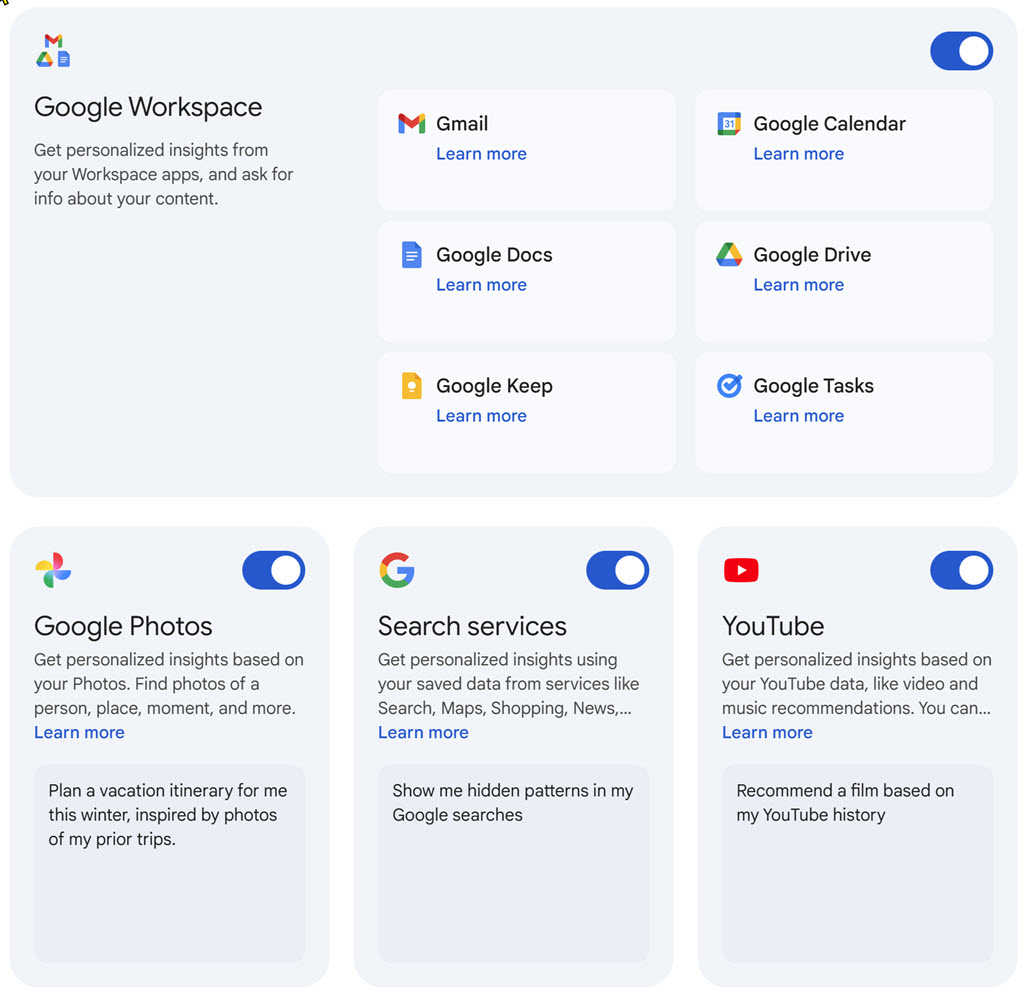
If you turn on “Personal Intelligence,” Gemini becomes an assistant who knows your life. Gemini is able to look at almost everything Google knows about you – everything in Gmail, your search history, your Google calendar, Google photos, and your files stored in Google Drive. Then it refers to all that data if it helps answer your questions. It can tell you your car’s license plate number by looking at the picture you took in an airport parking lot. When you’re planning a trip, it can combine information from hotel reservations in email and the packing list in Google Drive to give you travel suggestions. You don’t have to repeat yourself or supply background information.
Two things about that.
One: the information remains private. No one else can see your data. Your info is not being used to “train” the AI. It’s still private!
Two: get over the whole “eww, creepy” thing. Google already knows everything about you. It has your mail and your files, it knows what websites you visit and what you search for, it has analyzed your pictures. It’s way too late to be creeped out that Google knows so much. The only thing you’re doing when you turn this on is letting Google’s AI do a better job because it knows more about you. That’s a good thing, not a creepy thing.
Gemini also remembers what it learns about you during chats. Like ChatGPT, it keeps those memories for longer if you have a paid plan. But that’s separate from what Gemini is keeping up on by looking at your mail and photos. And again, that “Personal Intelligence” feature will be handled by the free plan shortly.
So why pay for Gemini? Well, you’ll get better AI models with the Gemini paid plan. You’ll be able to use “Deep Search,” which does a sweeping Google search and works with dozens of sources to produce a well-researched report with citations. The paid plan expands the space available for Gemini to work with entire manuscripts of books or large datasets. If you need help with bigger projects, Gemini’s paid plan is a no-brainer.
If you’re just a person, maybe those don’t seem important. There are also the other carrots dangled by Google for the paid plan – 2Tb of storage space for photos, Gmail, and files; more cool stuff in NotebookLM; and some other things.
That’s a long answer to the question of whether it’s worth it for you to spend money on a paid AI plan. The answer will be different for each of you. So here’s a suggestion (and I’m 100% serious): ask ChatGPT or Gemini to help you decide. They’re really good at advice. Try it!