
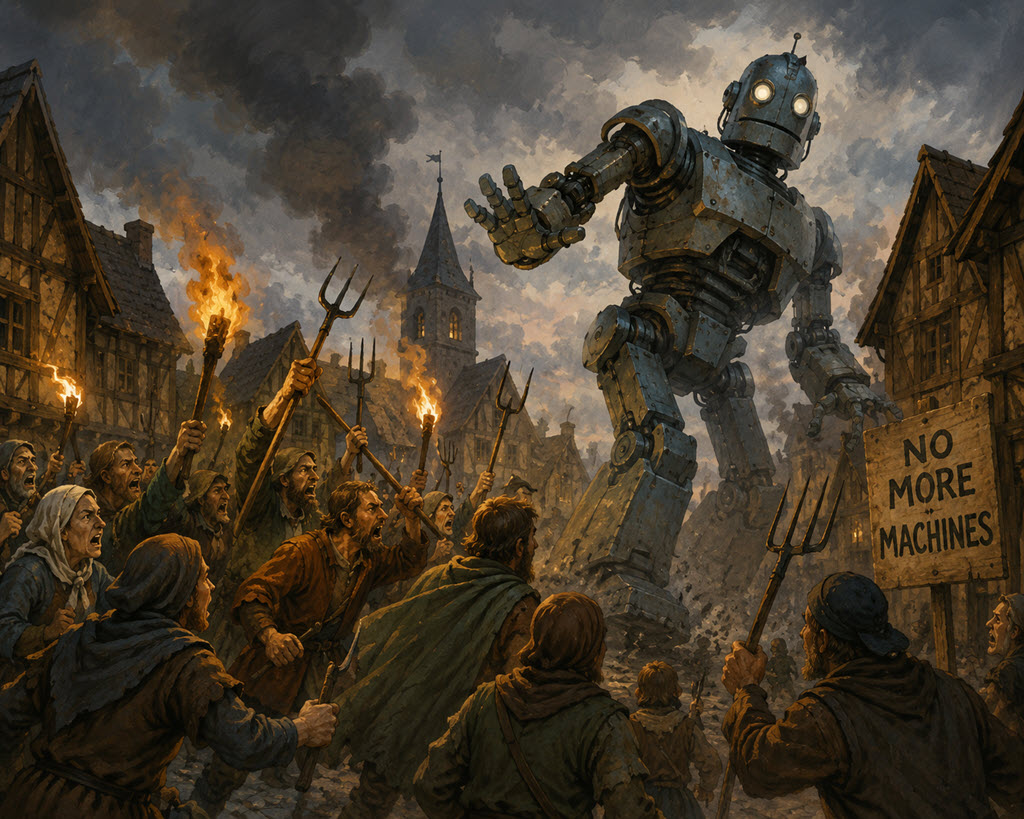
AI is the new supervillain. Villagers are reaching for their pitchforks. People really don’t like AI. They don’t trust it and they don’t think it will be good for themselves or the world. The Economist predicts that “the AI backlash is only getting started.”
The polls and the pushback, maybe your own feelings, are about the big picture, not about your personal use of AI. (You should use it.) I’ve been telling you for a while that AI’s effects on society will be messy, complicated, and uneven. Everything you hear, every opinion about AI, every viewpoint, it’s all true. It’s the best; it’s the worst; it will solve hard science problems and make life better; it might destroy civilization.
I’m going to list briefly some of the reasons that people have soured on AI. You’ll see evidence of them in the headlines this year.
One of them, about the behavior of the billionaire CEOs running the AI companies, deserves some extra scrutiny. The more I thought about it, the more I realized they have acted immorally, unforgivably, and they have hurt us.
Fun, right? Let’s dive in.
Why people hate AI
FEAR
People are afraid of AI. They’re afraid of a jobs apocalypse that will put people out of work and leave young people with nowhere to start their careers. They fear the possibility that a rogue AI will destroy civilization. They fear the power that hackers will have when they use AI to create cyberweapons. Majorities of people now believe that AI will worsen our creativity, our ability to form meaningful relationships, our decision making, and our problem solving.
One of the primary reasons people worry about the havoc that AI might unleash is because the tech company CEOs told us it might cause devastation. We’ll talk more about that next week.
RESENTMENT
AI is being forced on us, particularly for employees in businesses who are ordered to use AI. Often it feels as if the companies are disregarding the opinions of the employees about whether AI can effectively do their jobs. Many companies are adopting AI without any demonstrated results.
Meanwhile Google has converted web searches into an AI experience. You may think that’s a step forward or backward, but it’s important that it happened whether you like it or not.
Of course people are defensive as they seek to retain control over their careers, their privacy, and local environments.
OPPOSITION TO DATA CENTERS
Data centers are blamed for rising energy costs, issues with water quality, noise and light pollution, and greenhouse gas emissions. It’s easy to sympathize with complaints from communities dealing with a low mechanical drone from the ugly new buildings, like the endless hum of a jet engine that never takes off and is impossible to tune out.
There are more than 4,500 active data centers in the US today, with another 800 under construction, and more than 1,700 in various stages of the development pipeline.
Public sentiment has turned overwhelmingly against construction of new data centers. In the first quarter of 2026 citizen protests, environmental objections, and local land-use fights blocked or delayed 75 data center projects worth $130 million.
A few days ago there was a headline about a county in Virginia with 37 data centers that told its schools to “turn off your lights” to save electricity before a scorching heat wave because of rising electricity rates. Is it any surprise that mobs are gathering their pitchforks and torches?
ANGER OVER SURVEILLANCE PRICING
“Surveillance pricing” is a term for companies charging you more for things you search for based on how much the algorithm thinks you can afford. It’s been under way for several years but AI is being used to supercharge it. When you’re offered different prices than the person sitting next to you for an Uber ride or a flight or groceries, you’re going to blame AI, and with good reason.
Companies have also started using AI to evaluate surveillance data on potential and current employees, including whether they’ve taken out a payday loan, their personal credit, their social media activity, and how quickly they’ve taken other job offers, to determine the lowest salary they might accept or whether they’ll stay without getting a raise.
LACK OF TRUST
The reports of hallucinations have created the perception that AI is unreliable and easy to misuse. You might instinctively agree or you might feel the concerns are overstated, but many people today are skeptical and dismissive of AI because they don’t believe it’s trustworthy.
DISILLUSIONMENT WITH THE OLIGARCHY
Americans don’t like Big Tech CEOs. It’s a credibility catastrophe.
People don’t like what they learn about the tech leaders’ personal lives – think Jeff Bezos on his superyacht sailing to Venice for his opulent marriage to Lauren Sanchez. There are some CEOs that people just viscerally don’t like (*cough* Mark Zuckerberg *cough*).
People don’t like the political overtures to the Trump administration, whether it’s Tim Cook groveling before Trump with offerings of gold, Sam Altman contributing $1 million to Trump’s inauguration fund, or Elon Musk taking a DOGE sledgehammer to the government last year as part of his descent into madness.
The Big Tech CEOs working on AI are the most visible tip of the much larger iceberg: a growing disillusionment with all of the ultra-wealthy in the United States. We’re angry about the political influence that the hyper-wealthy wield to buy media platforms, stifle regulation, sway public policy, and increase their own wealth at everyone else’s expense, without any moral compass.
So it shouldn’t be any surprise that we personalize our fear and anxiety about AI. It’s the AI tech leaders who continue to develop AI technology at breakneck speed even while they warn that it could unravel the fabric of human civilization.
I have more to say about the CEOs and their misbehavior. They bear moral responsibility for harm caused by AI. Let’s talk about that next week.