The Olympia Press was a notorious Parisian publishing house that used a legal loophole to mass-produce cheap, pseudonymous English erotica for tourists in the 1950s. Olympia Press was owned by Maurice Girodias, a chaotic businessman who had an eye for avant-garde masterpieces like Lolita but all too often took advantage of his authors.
I’ll give you some background about Nabokov and a few others who tangled with Girodias, then focus on two stories: a tragedy about Girodias and the 1968 shooting of Andy Warhol; and a decades-long legal blood feud with author J.P. Donleavy over The Ginger Man that has a surprise twist and a happy ending.
Lolitigation and more
Vladimir Nabokov immediately regretted his contract with Girodias for Lolita. Later he described Girodias this way:
“From the very start I was confronted with the peculiar aura surrounding his business transactions with me, an aura of negligence, evasiveness, procrastination, and falsity. . . . What always made me regret our association were not “dreams of impending fortune,” not my “hating” him “for having stolen a portion of Nabokov’s property,” but the obligation to endure the elusiveness, the evasiveness, the procrastination, the dodges, the duplicity, and the utter irresponsibility of the man.”
Olympia Press contracts were legendary in the publishing world for being predatory and financially suffocating. The Lolita contract had clauses buried in it that purported to make Olympia Press a permanent co-owner of the book, entitled to an exorbitant 33% cut of all future royalties from any country’s publication. Nabokov hired a powerful American legal team, coining the term “Lolitigation” for the legal and bureaucratic warfare that played out for years.
Nabokov was lucky; he was eventually able to regain control of the copyright and the royalties. William Burroughs came to despise Girodias after Olympia Press published Naked Lunch, calling him a parasite who exploited the vulnerabilities of desperate artists. Terry Southern lost millions of dollars when pirate publishers flooded the market with unauthorized editions of the novel Candy because Girodias failed to file copyright paperwork.
They weren’t the only ones enraged by Maurice Girodias.
The shooting of Andy Warhol
In 1968 artist and cultural icon Andy Warhol was shot and nearly killed by Valerie Solanas as they rode up an elevator together at Warhol’s New York studio.
Solanas was the author of SCUM Manifesto, a radical feminist text published the year before by the newly minted New York branch of Olympia Press. True to form, Girodias had inserted a predatory option clause into the book contract with Solanas, not only taking away her rights to SCUM Manifesto but also purportedly giving Girodias legal ownership of all her future unwritten literary work. In her mind, she had sold her soul and her intellect into permanent capitalist slavery.
By 1968 Solanas’ mental health was rapidly deteriorating. After a disagreement with Warhol, she became convinced that Girodias and Warhol were engaged in a massive conspiracy to control her life and steal her intellectual property.
On the morning of June 3, Solanas went hunting for both men, carrying a .32-caliber automatic pistol. Her first stop was the Hotel Chelsea, where Girodias was staying, planning to demand her contract back or kill him. When she found out that Girodias was out of town for the weekend, she walked over to Warhol’s studio, rode the elevator up with him, and shot him in the torso, nearly ending his life.
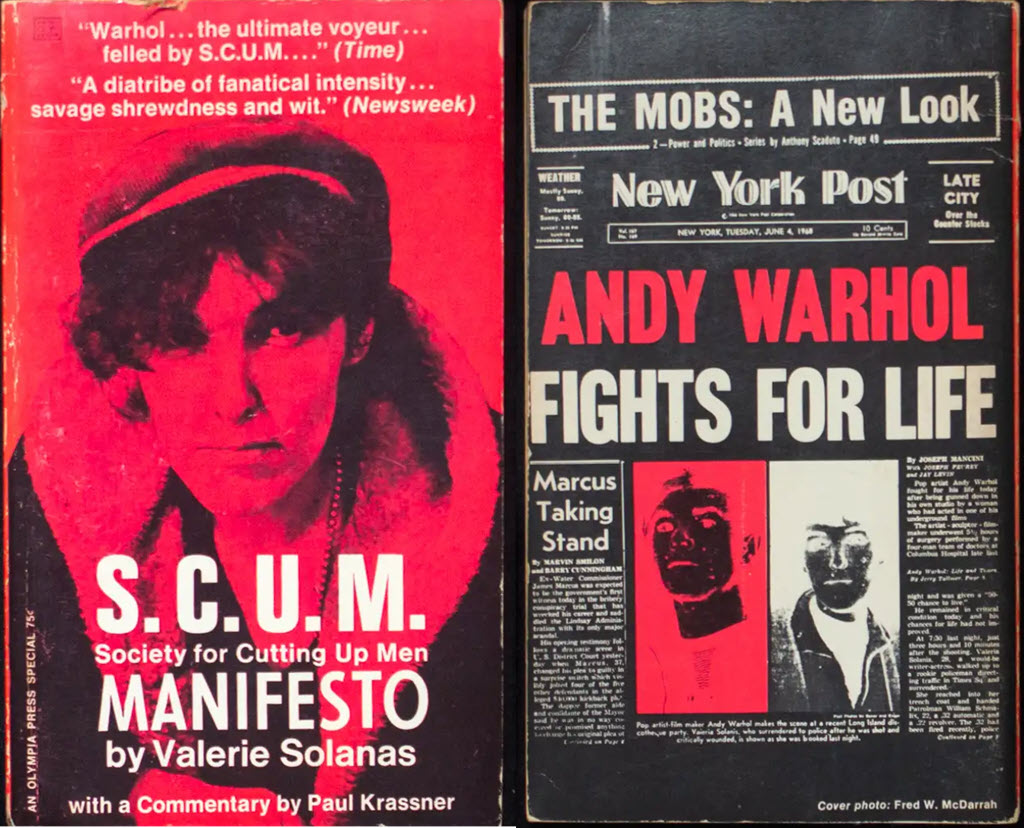
Girodias responded to the tragedy by slapping references to the Warhol shooting on the front cover of SCUM Manifesto along with a sensationalist back cover (“ANDY WARHOL FIGHTS FOR LIFE”) and loudly telling reporters that he was the true target to drive up book sales.
Valerie Solanas wanted to kill Maurice Girodias. Author J.P. Donleavy wanted something worse: he wanted to outlast him and drive him to ruin. That’s our last story.
The Ginger Man
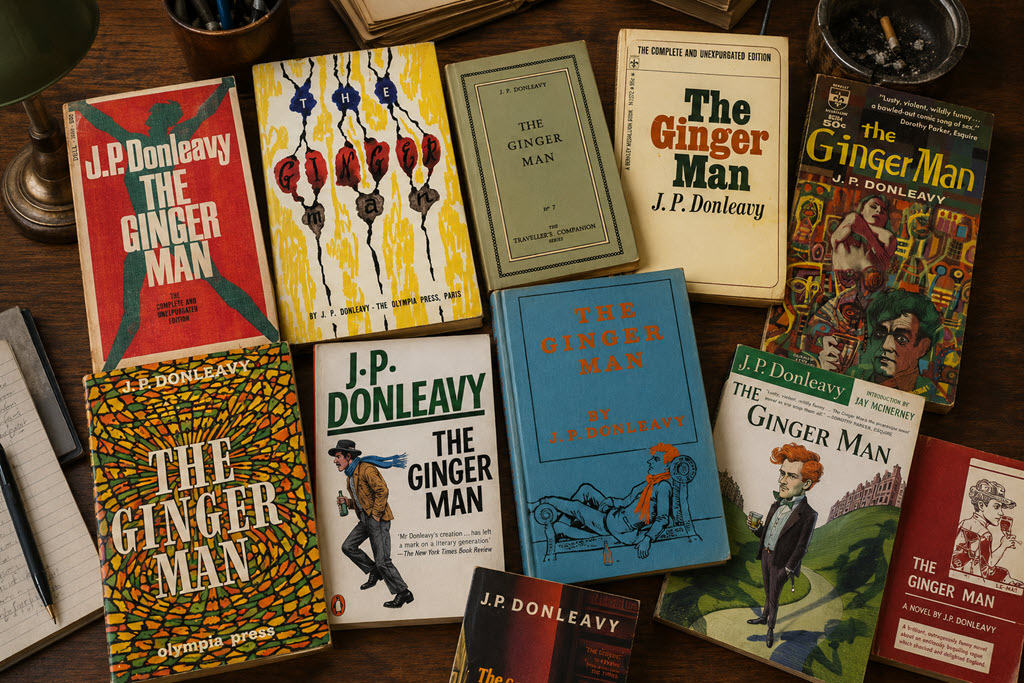
J.P. Donleavy’s The Ginger Man is a comedic masterpiece that altered the literary landscape and shattered censorship boundaries in the 1950s. It became one of the bestselling books of all time, 45 million copies sold worldwide, never out of print, named one of the 100 Best Novels of the 20th Century by Modern Library. Johnny Depp has longed to make a movie for decades about the protagonist Sebastian Dangerfield, the “patron saint of incorrigible, debauched, but conversely lovable bastards. . . . If it were not for the elegant artistry of J.P. Donleavy and his dear despicable Sebastian, there would have been no Hunter Thompson with his Fear and Loathing In Las Vegas.”
The Ginger Man was rejected by major British and American publishers for its explicit sexuality, blasphemy, and generally unrepentant protagonist, until the manuscript found its way to Maurice Girodias in Paris. Donleavy signed a contract with Olympia Press and Girodias published the book in June 1955.
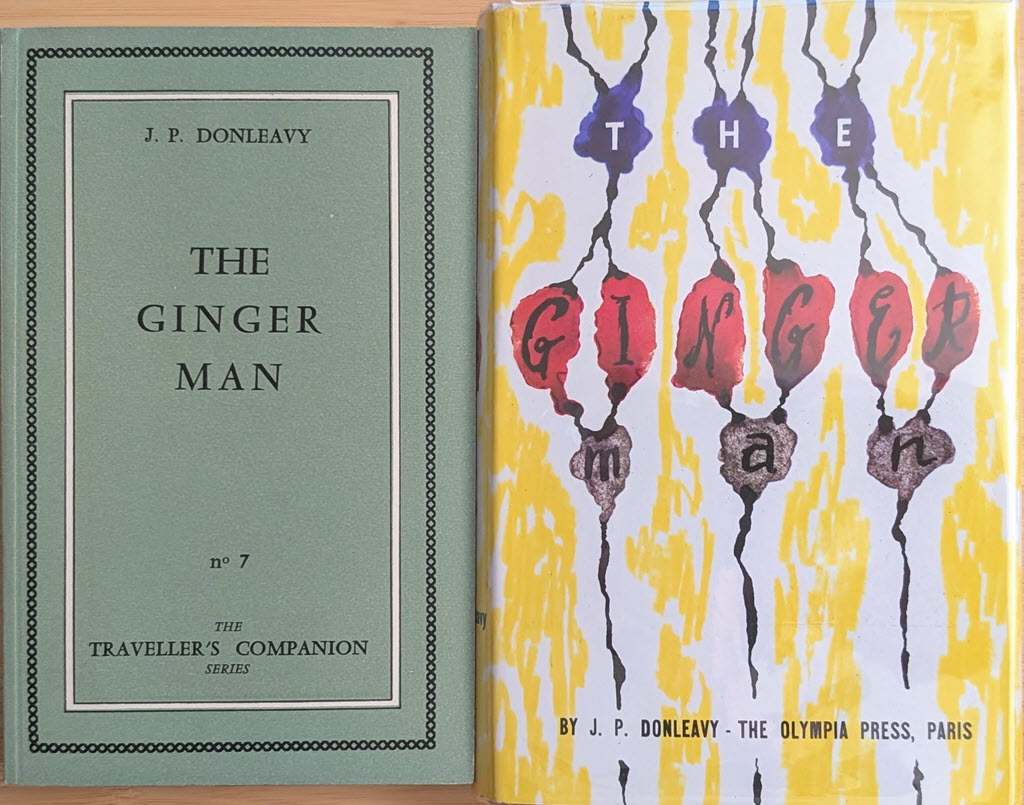
Donleavy’s excitement turned to absolute fury when he received his copies. Girodias had issued The Ginger Man as No. 7 in the newly minted Traveller’s Companion Series, bound in the same cheap green wrappers as White Thighs and The Sexual Life of Robinson Crusoe.
Donleavy felt degraded and tricked into being branded a pornographer. He wrote later: “I smashed my fist upon its green cover and I declared aloud, ‘If it’s the last thing I do, I will avenge this book.’”
For more than two decades Donleavy never stopped pursuing Girodias, a feud fueled by Donleavy’s burning sense of betrayal and an unyielding vow for vengeance. He wore Girodias down by turning the legal system into an instrument of pure attrition, bleeding the publisher of resources and patience for twenty years until Olympia Press was pushed to the brink of total financial collapse.
By the late 1950s, the conservative French government had begun to crack down on Girodias. He faced constant police raids, book seizures, and heavy fines. Under pressure, he relocated to New York City in 1967 but struggled to compete now that he no longer had a monopoly on “forbidden” books.
When Girodias finally went bankrupt under the weight of his endless legal battles and government crackdowns, the assets of the Olympia Press were put up for public auction in Paris. Girodias attended the auction with all his remaining money, intending to buy back the Olympia Press name.
At the front of the room, the French liquidator cleared his throat. A small crowd of Parisian book dealers and minor creditors looked on. The lot was called: The assets, remaining stock, and copyrights of The Olympia Press.
Each time Girodias or a rival dealer placed a bid, an unknown woman named “Mrs. Price” countered. The bidding was swift but half-hearted. Girodias placed bid after bid, and each time the woman calmly raised her hand to counter.
Girodias ran out of money. The mysterious woman placed the highest bid and the hammer fell.
Mrs. Price stood up, adjusted her coat, and walked to the clerk’s desk to sign the papers. Girodias watched her, the first shadow of a terrible realization crossing his face. She caught his eye, offering a polite, devastatingly brief smile.
Mary Price was J.P. Donleavy’s wife, sent with a large sum of cash to buy Olympia Press as the author’s final revenge.
Maurice Girodias spent his final years in Paris writing his memoirs in relative poverty before dying of a heart attack in 1990, leaving the press he founded entirely in the hands of the author he had spent a lifetime fighting.
Donleavy retained ownership of Olympia Press for the rest of his life but closed it in a drawer and never brought it to life. It was purely a defensive trophy and a final act of closure.
The Ginger Man still reads well today – funny, manic, like being swept along on an intoxicating breakneck joyride through the grimy alleys of Dublin. Five stars, recommended!