
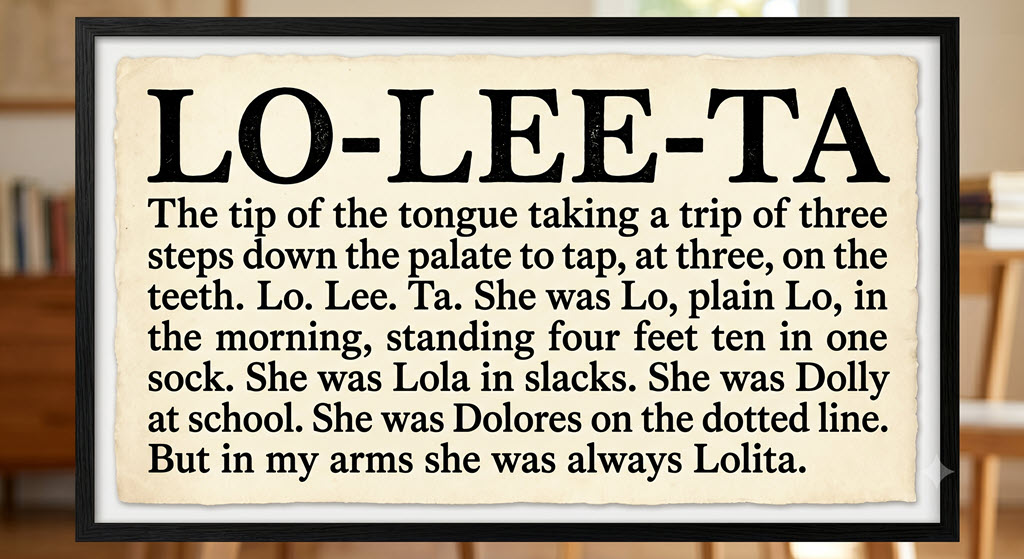
Lolita, light of my life, fire of my loins. My sin, my soul.
Those are the opening lines of Lolita, Vladimir Nabokov’s dazzling literary masterpiece. Lolita was an international bestseller that reshaped modern fiction and established Nabokov as one of the twentieth century’s greatest novelists. There’s a great story about why the first edition was a cheap paperback with a plain green cover to make it easy to hide in a suitcase.
When you bring back memories of Lolita, you think of breathtaking linguistic artistry and psychological complexity, right? No? Sigh. Let’s get the difficult bit out of the way:
Lolita is the story of a middle-aged pedophile who abducts and sexually exploits a twelve-year-old girl.
It’s a premise that is still shocking in 2026. In 1950 it was nearly unimaginable that it could ever be published. After years of writing and revision, Nabokov was plagued by doubts, so much so that he walked out to the garden incinerator intending to burn the index cards holding the draft of the novel. His wife Vera physically stopped him and insisted he finish the book and submit it to publishers.
Oh, dear, you’re already getting distracted and we’ve barely begun. Yes, index cards – Nabokov wrote most of his novels on 3”x5” cards, writing individual scenes, paragraphs, or even sentences as they came to him and then putting them in order later. Interesting, but that’s not the important part. Stay focused.
Nabokov was a tenured professor at Cornell University when he finished Lolita in 1954. Censorship laws were so strict that he feared losing his job or facing obscenity charges under the strict Comstock laws of the era if the manuscript was intercepted. He hand-carried the manuscript to major publishing houses in the US, asking them to publish it under a pseudonym. The editors admired Nabokov’s extraordinary prose and recognized that the novel was a major literary achievement – and every single one turned it down out of fear of prosecution. One editor warned that they would all go to jail if it were published.
In desperation, Nabokov sought a publisher in Europe. He hired a literary agent who connected him with Maurice Girodias in Paris.
Olympia Press and The Traveller’s Companion
Maurice Girodias was a flamboyant, perpetually bankrupt Frenchman who ran a notorious operation called The Olympia Press. In the next article I’ll tell you more Olympia Press stories.
To pay his bills, Girodias hired destitute expatriate writers to churn out explicit pornography. But Girodias also possessed a genuine, avant-garde appreciation for high art, so he also published literary works with erotic themes – novels by William S. Burroughs, J.P. Donleavy, Samuel Beckett, Jean Genet, and Henry Miller among them.
France had strict obscenity laws on the books, just like the US and Britain. But Girodias had discovered a fascinating legal loophole: the French government allowed the printing of sexually explicit or controversial books if they were written in English and designated for export.
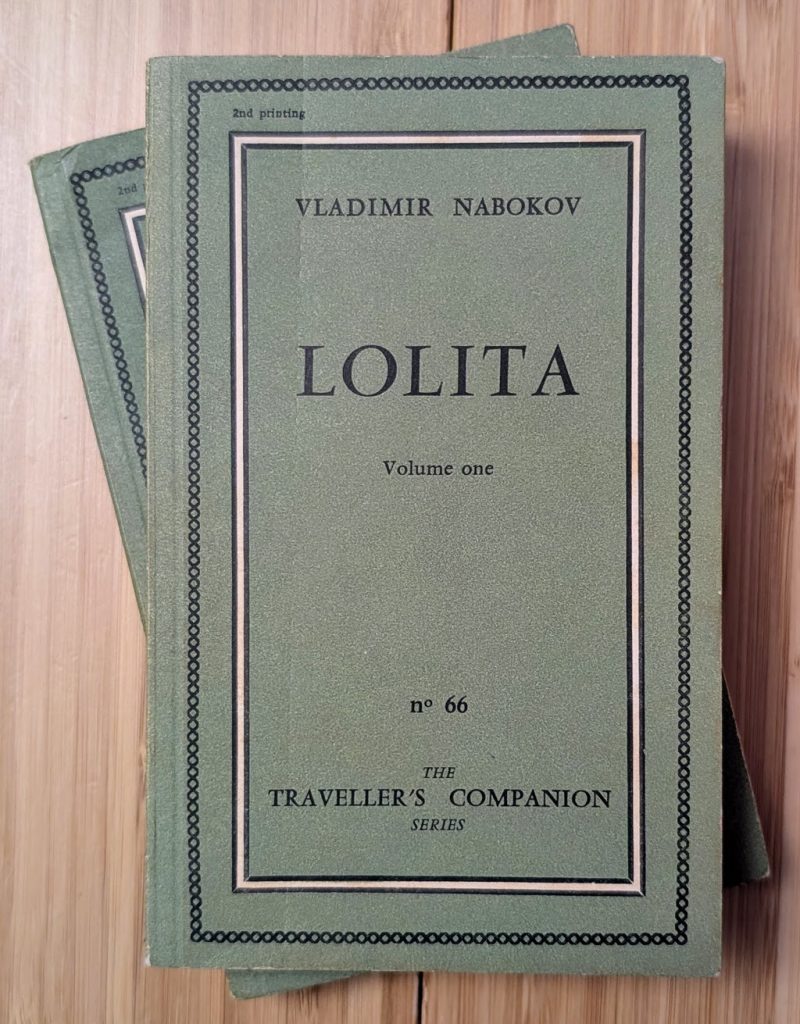
Girodias used this loophole to create the Traveller’s Companion series—a line of cheap, pocket-sized paperbacks wrapped in plain, uniform green covers. Most of them were highly explicit erotica and tales of sadomasochism and discipline. The books were deliberately designed to look boring so English and American tourists could easily hide them in their luggage and smuggle them past customs officials.
Conventional French publishers would have turned down a French translation of Lolita, but when Girodias read Nabokov’s manuscript, he recognized its genius and signed a contract with Nabokov.
In September 1955, Lolita was officially published in Paris by Olympia Press as number 66 in the Traveller’s Companion series. It was issued as a two-volume set, bound in the generic pea-green pornographic wrapper.
Those cheap green paperbacks pictured above are the true first edition of Lolita, made to be unnoticed at the bottom of a suitcase.
Lolita becomes a sensation
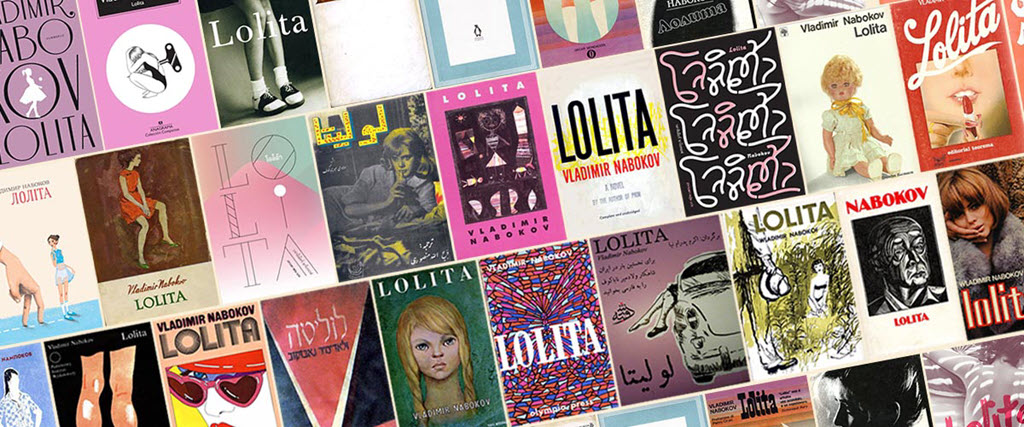
Then a British critic changed everything. A few months after publication, novelist and critic Graham Greene declared in the Sunday Times that Lolita was one of the three best books of the year.
Alarm bells went off in the offices of public censors and prudes. John Gordon of the Sunday Express denounced the novel as “the filthiest book” he had ever read, launching a public feud over whether Lolita was a masterpiece or moral poison. Gordon’s attacks almost certainly sold more copies than Greene’s praise.
The argument also triggered official scrutiny. British customs officials began seizing copies entering Britain. The French government eventually issued a formal ban of Lolita and other Olympia Press books.
Today we call it the “Streisand effect”, after a famous incident when Barbra Streisand attempted to remove an aerial photo of her Malibu house from California’s public records – directly causing hundreds of thousands of people to download the photo. Censorship makes people want to see what is being hidden from them.
Lolita was famous enough to be notorious but hard to obtain legally. Nabokov waited nervously, wondering if he would be fired, reassuring interviewers that he did not endorse Humbert Humbert’s views and didn’t intend him to be a hero.
The controversy over Lolita was still raging two years later and American publishers saw an opportunity. G.P. Putnam’s Sons bought American publication rights and launched Lolita in 1958 with a burst of publicity.
There have been few publishing events like it. Lolita was an immediate bestseller, the first book since Gone With The Wind to sell more than 100,000 copies in its first three weeks on the market. It climbed to number 1 on the New York Times Best Seller List and stayed near the top for six months. When the paperback was released a year later, it went through eight printings almost immediately to keep up with demand. A British publisher released an authorized edition and the French government revoked its ban.
Director Stanley Kubrick bought the film rights for a whopping $150,000 (equivalent to well over $1.5 million today), plus a lucrative contract for Nabokov to write the screenplay. Nabokov retired from Cornell and moved to Hollywood to work on the script for a year. It’s ironic and wonderful that Vladimir Nabokov, the most literary of the literary giants, has an Academy Award nomination.
The staggering financial success of Lolita allowed Nabokov to devote the rest of his life to his writing. After his Hollywood year, he lived with Vera in the Montreux Palace Hotel, a magnificent Belle Époque luxury resort on the shores of Lake Geneva, for the rest of his life.
Lolitigation
That’s not the end of the story. Nabokov referred to the final chapter of his dealings with Olympia Press as “lolitigation.” In the next article I’ll tell you the wild tale of artistic betrayal and back-alley accounting that broke the bank for Paris’s most notorious outlaw publisher.